Introduction
The two main churches in Cortina d'Ampezzo are the Basilica of Saints Philip and James, which is the most central one, and the Church of Our Lady of Defense, which is located near the cemetery. There are also seventeen smaller churches to discover. Let's explore them together!

Straight to the Point
This article is quite discursive and long. If you only need to quickly find info about a specific church, you can click it on the list below to jump to the specific section, or you can use the table of contents at the bottom of the page.
- The Basilica of Saints Philip and James, Santi Filippo e Giacomo.
- The Church of Our Lady of Defense, Madonna della Difesa.
- The Little Church of Saint Francis, San Francesco.
- The Church of Saint Roch, San Rocco.
- The Little Church of Saint Candide, San Candido.
- The Little Church of Saint Juliana, Santa Giuliana.
- The Little Church of the Blessed Virgin of Lourdes, Beata Vergine di Lourdes.
- The Little Church of Saint Anthony, Sant'Antonio.
- The Little Church of Our Lady of Health, Madonna della Salute.
- The Little Church of St. Nicholas and St. Blaise, San Nicolò e San Biagio.
- The minor chapels.
The Basilica of Saints Philip and James
The Parish Church of Cortina d'Ampezzo, dedicated to the Saints Philip and James, is a church in a classic Baroque style. It was built between 1769 and 1775, and it was designated as a minor basilica in 2011. In Italian, it is called Basilica dei Santi Filippo e Giacomo.

The construction started in 1769, on the foundations of two earlier religious buildings ,and developed on a single nave with shallow niches. Inside, it houses some of the most significant works of Ampezzo Christian art, including paintings by Ghedina and Gillarduzzi, who are both painters born in Cortina.
Once inside, your attention will immediately be captured by the impressive High Altar, created in 1773 in wood decorated with polished stucco by Johannes Mussack Jr. The altarpiece was painted by Antonio Zanchi in 1679 and depicts the Madonna with Saints Philip and James; this artwork had been painted prior to the altar, but it was later adapted to fit within it.

The nave ceiling was entirely decorated by Franz Anton Zeiller between 1774 and 1775. The panel closest to the entrance depicts the martyrdom of Saint James. The central panel shows the expulsion of the merchants from the temple, and it's framed by the representations of the four evangelists. The third panel, the farthest from the entrance, illustrates the martyrdom of Saint Philip.

The ceiling above the altar has been frescoed in a second moment by Giuseppe Ghedina and shows the Holy Trinity. This work was commissioned by the town in 1859. Another fun fact? Giuseppe Ghedina served as director of the Cortina Art School from 1880 to 1883.

Inside the church there are four side altars; the most important is the one to the left of the main entrance, near the door. It is the Altar of Our Lady of the Rosary, crafted in 1703 by the workshop of Andrea Brustolon, a sculptor from the Cadore Valley trained in Venice. He's well known for having decorated many of the most beautiful churches around the province. His works can also be found in Rome and Venice.

Opposite to Brustolon's altar there's a gilded wood altar, dedicated to Our Lady of Mount Carmel. In the upper part of the altar there's a Venetian school altarpiece dated 1693, attributed to Antonio Lazzarini, which represent the Madonna Distributing Scapulars to Carmelite Saints.
Beside the main altar there are two side altars of particular interest. Using the entrance door as a reference once again, the left altar contains the relics of Saint Theophilus, Santo Teofilo in Italian, and houses Our Lady of Sorrows, the only artwork by the local artist Luigi Gillarduzzi displayed in Cortina. The reason is that he moved to Austria, where is known whith the pseudonym Alois Gillarduzzi.
On the altar on the right, there are the relics of Saint Liberalis, San Liberale in Italian. There you can also admire an altarpiece by Giuseppe Ghedina depicting Saint Joseph with the Child Jesus. There is a fascinating detail in this painting: the depiction of mid-19th-century Cortina at the feet of the saint has been added later by Ghedina's descendants.

Before exiting through the main door, you should look up to admire the splendid 1954 organ, an instrument with 3,078 pipes, built by the Mauracher company of Linz. It is designed to perfectly match the acoustics and artistic style of the basilica. In 2002, master organ builder Andrea Zeni restored the organ, returning the instrument to its former glory.

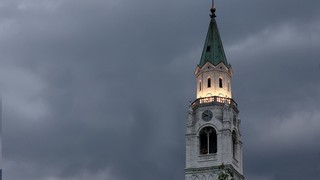
Before concluding this chapter, we must mention the bell tower of the Basilica. The tower is seventy-three meters tall, two hundred-forty feet, and was erected in 1852 by Silvestro Franceschi. The bell tower is made of dolomite, the same white rock that forms the Dolomites and the flooring of the Basilica.
If you'd like to learn more about the most iconic building in Cortina, we invite you to read the page we've written on the subject:
The Church of Our Lady of Defense
The Church of the Blessed Virgin of the Defense is the second largest church in Cortina. It is located near the cemetery, and behind a modest facade are hidden rich interiors. In Italian, it is called Chiesa della Beata Vergine Maria della Difesa.
The building was erected in 1750, on the same position as a small church of the 14th century. The facade is very simple and features only a delicate fresco of the Madonna of the Defense, to whom the church is dedicated.

Devotion to the Madonna of the Defense is deeply rooted in Ampezzo, due to two miraculous events attributed to the Virgin.
The first event happened in 572, during the Lombard invasion of the Cadore valley. It is said that the Virgin confused the attackers with a cloud, causing them to fight among themselves.
The second event took place when a small group of locals managed to stop Emperor Sigismund's imperial troops at the Cimabanche pass. The win was so unlikely that it entered local lore as a divine intervention.
Despite its simple exterior, the church boasts a rich interior with abundant use of gold leaf and frescoes. What stands out most is the ceiling, decorated by Valentino Rovisi, an artist from the nearby Trentino area and probable pupil of Giambattista Tiepolo.
The large fresco depicts The Virgin's Intervention in Defense of the Ampezzo People in Battle, showing the Madonna holding a sword in memory of Ampezzo's victory over the soldiers of Sigismund of Luxembourg in 1412.

The High Altar is in Baroque style and houses a richly adorned wooden statue of the Madonna of the Defense. The altar, the statues of San Sebastiano and San Rocco, the columns, and the angels are crafted from wood, either gilded with gold leaf or painted to resemble marble. It was built in 1747 by the master craftsman Domenico da Brunico.

On the apse, to the right and left of the High Altar, are two paintings by Franz Anton Zeiller, the same artist who painted the ceiling of the Basilica of Saints Philip and James. These works were transferred here in 1881. They respectively portray Our Lady of Sorrows with the dead Christ on her lap and The Madonna and Child between Saint James the Less and Saint Teresa of Avila.
The interior of the church is enriched by paintings to simulate marble columns and frames, which were painted in 1908 by the Peskoller brothers. These visual tricks give the impression of a space larger than it actually is.

From 1941 the Church of the Blessed Virgin of the Defense was kept by the Franciscan Friars Minor. In 2020 they departed from Cortina, so the management of the sanctuary returned to the local parish.
The Little Church of Saint Francis
Let's see now the final place of worship in the center of Cortina: the Little Church of Saint Francis, known in Italian as La Chiesetta di San Francesco.
It was first mentioned in 1396, although its origins are likely even earlier. Unlike all the other churches in town, the Little Church of Saint Francis is privately owned by the Constantini family.
In 2022, this little church was restored to its former splendor thanks to funds raised through advertising banners placed on the structure during the two-year restoration.

Inside, visitors can admire precious 14th-century frescoes, partially recovered, depicting Saint Bartholomew, Saint Matthias, and Saint Jude Thaddeus. There's also a small grotto of Lourdes, created in 1913 to house a statue of the Virgin Mary, crafted in the Val Gardena style. A similar work can also be seen in the Church of Our Lady of Lourdes, in the locality of Grava.

The church's facade hosts a fresco of great historical value, depicting Saint Francis. Its uniqueness lies in the fact that in 1718 it was covered after being struck by lightning. During the 2022 restoration, it has been revealed again, restored to its original beauty.
The spot where the lightning struck is still clearly visible; the modern Italian philosophy of restoration prefers to leave damage exposed rather than arbitrarily reinterpret a partially lost fresco.
The Church of Saint Roch
The Church of Saint Roch, known in Italian as Chiesa di San Rocco, is located in the area of Zuel. It is dedicated to Saint Roch of Montpellier, venerated as a figure of hope during the plague. It was consecrated on September 10, 1604, and is the only rural church in the area where religious services have been held regularly until a few years ago.

Inside, visitors can admire the splendid 1926 altarpiece by Johann Matthias Peskoller, who also created the Via Crucis and the fresco on the facade, depicting the people gathered around the Heart of Jesus. Of particular interest are also the two wooden statues of Saint Roch and Saint Sebastian, carved by Matteo Fiori de Ruseco.

In the left-hand chapel there is the Cristo de Zuel, a wooden crucifix discovered in 1695 in a barn. Considered a miraculous event, it was donated to the Church of Zuel, where it's still preserved today.
The last artwork worth mentioning is a painting by Dino Degasper, commemorating the devastating fire of 1945 in Zuel. It may have been arson, and according to tradition, the church was miraculously spared, thanks to the providential intervention of Saint Roch.
The Little Church of Saint Candide
The picturesque little church of Saint Candide, in Italian Chiesetta di San Candido, is located in the area of Campo di Sopra. It's a small octagonal chapel that contains three stylistically distinct altars. It was built in 1740 as a vow by the village of Campo di Sopra against the repeated fires that had afflicted it.

The central main altar houses a late 17th-century painting depicting Saint Florian extinguishing a fire, with his head turned toward the Holy Family, seeking their protection. The left wall features an altar that originally came from the Church of St. Roch in Zuel, portraying Saint John the Baptist. It is strongly inspired by a painting by Titian representing the same subject.

The right altar is the true treasure of this church. It's a wooden altar from 1549 created by Michael Parth, originally intended for the now-lost Church of Saint Catherine. This winged altarpiece, with movable panels, is a masterpiece that showcases all the Tyrolean craftsmanship in composition, sculpture, decoration, and wood painting. These works are also known as Flügelaltar.

Before we finish, here are two curiosities:
- The bell tower's clock comes from Podestagno Castle and dates to 1618.
- Interestingly, there is no image of Saint Candide in the chapel, even though it is named after him.
- There are four images of Saint Florian, as he's venerated as a protector against fires and floods.
The little Church of Saint Juliana
The Church of Saint Juliana, known in Italian as Chiesa di Santa Giuliana, is located in the area of Alverà. It's a small church that contains some of the finest examples of 17th-century wooden sculpture in the Ampezzo area. The chapel was consecrated on September 5, 1716, after the Patriarch of Aquileia ordered its completion. Construction had begun in 1692 but was halted due to lack of funds.

Upon entering, your gaze is immediately drawn to the precious Baroque wooden altar from the early 18th century, one of the most beautiful in the valley. The richly decorated altar houses a Venetian school altarpiece dated 1692, depicting the Madonna and Child, Saint Giuliana, and Saint Anthony of Padua.

Two other works are sure to catch your attention. The first is a painting by Luigi Ghedina Tomash, dated 1863, which depicts the Virgin and Child seated on a throne of clouds, from which a ray of light falls on the chapel of Alverà. The second artwork is dated 1692 and is by an unknown artist. It depicts Saint Juliana in prison, comforted by a little angel, dressed and adorned like a wealthy court lady.

On the left wall, housed in a display case, is a small Madonna with a pomegranate. This sculpture, from the 1400s by an unknown master of the Val Pusteria, is carved from elm wood and is probably the most valuable work preserved in the church.
The Little Church of Our Lady of Lourdes
The Church of Our Lady of Lourdes is known in Italian as Chiesa della Beata Vergine di Lourdes. Located in the area of Grava, it's a small chapel consisting of a single nave and six windows. It was inaugurated in 1909, and it was built by the villagers with the purpose of constructing a church larger than that of their neighbors, the village of Chiave.

The interior of the church is very simple and is mainly appreciated for the sculptures by Corrado Pitscheider, an artist from the Val Gardena. The most striking work is undoubtedly the depiction of the Archangel Michael, who, with sword drawn, drives Lucifer back into hell. Also by the same artist is the statue of Saint Lucy, who holds in a cup the eyes that were torn from her.

The last impactful artwork can be found behind the altar, where a reconstruction of the Grotto of Massabielle is visible, representing the moment when the Blessed Virgin appeared to a shepherd girl named Bernadette. A very similar work can also be found inside the little church of Saint Francis.
The Little Church of Saint Anthony of Padua
The chapel of Saint Anthony, known in Italian as Chiesa di San Antonio da Padova, is located in the area of Chiave. It's a small church dating back to 1791, which was completely rebuilt in 1809 after Chiave was struck by Napoleonic cannon fire. It's a very simple church, with an Austrian-style onion dome bell tower, which houses works of great craftsmanship inside.

The main altar, in Baroque style, features a painting of Saint John with Child by Giuseppe Lacedelli and is framed by two statues: on the left the Flagellated Christ and on the right Saint Catherine.
The left altar, dating back to the seventeenth century and from a Friulian workshop, is a beautiful example of gilded and lacquered wooden sculpture. The cross on the right was purchased by Enrico Gaspari Bechereto in Jerusalem and later donated to the church.

The chapel is dedicated to Saint Anthony of Padua, whom the village celebrates on June 13th with a small festival to which all citizens are invited.
The Little Church of Our Lady of Health
The Church of Our Lady of Health is known, in Italian, as Chiesa della Madonna della Salute. It's located in the area of Cadin di Sotto and was built in 1889 on the site of a previous chapel from 1787. It's dedicated to Our Lady of Health, which is celebrated on November 21. This feast is particularly significant in the Veneto region, thanks to the church of the same name built in Venice following the plague of 1630. However, it is said that the church in Cadin was erected as a vow for the healing of a paralyzed child.

The first artwork visible at the church entrance is the lunette that Giuseppe Ghedina painted as the final work of his career, in 1896. It depicts the Virgin with Child and welcomes visitors to the little church.
The interior, very simple, houses a painting of Saint Francis of Assisi and a Virgin Mary depicted in a votive offering from 1716, as well as two frescoes created by Alvise Zorzi in 1950 depicting Innocence Approaching Faith and the Miracle of Healing in Cadin, as previously mentioned.

The marble altar is in modern style and features a statue of the Madonna embracing the Child between Saints Joachim and Anne, by Francesco Tavella. Of great interest is the baroque wooden carved frame attributed to Andrea Brustolon, listing the patrons at the time of founding.
The Little Church of Saint Nicholas and Saint Blaise
The Church of Saint Nicholas, Saint Blaise, and Saint Anthony is known, in Italian, as Chiesa di San Nicolò, San Biagio e Sant'Antonio Abate. It stands at the northern border of the Cortina territory, near the locality of Ospitale, an ancient hospice dating back to the eleventh century, historically a rest stop for travelers heading toward Tyrol.
The church, consecrated on October 30, 1226, is the oldest building in Ampezzo. Much of the walls, still visible today, are original, while the wooden roof and the Gothic-style presbytery date back to the sixteenth century.

The little church of Ospitale is dedicated to Saint Nicholas, venerated in the Alpine region as the protector of travelers. Even though it's located in a rather isolated area, it has a strong connection with the people of Ampezzo. Every year, on the first Thursday after Pentecost, there is a walking procession from Podestagno to Ospitale; there the blessing of the pastures takes place.

The interior of the church is simple, almost bare, due to the looting it suffered over the centuries. Inside, you can observe 15th-century frescoes by an unknown local artist, once displayed outside, and the only remaining altar, which holds a panel painting from a German school, dating to the 16th century.
The wooden crucifix in the apse has been found at Ciampo de Croš; it is of unknown manufacture, but it's plausibly an artwork from a German soldier. Special attention should be given to the floor, made of larch planks, and the ceiling, which is the original one from the 16th-century.
The minor chapels
In this concluding chapter, we'll explore the lesser-known chapels, which are carefully looked after by citizen volunteers, who ensure their cleanliness and efficiency.
The first chapel we want to talk about is the Church of Sant'Andrew in the locality of Col. In Italian, it's called Chiesetta di Sant'Andrea. It was built in 1668 at the request of Father Francesco Colli to house the relics he had received as a gift from the Bishop of Bergamo. In 1839, the chapel was completely rebuilt, taking on its current appearance.

Inside, there is a small wooden altar, dated 1663, which hosts an altarpiece depicting the Madonna with Saints Andrew, Anthony, and Sylvester. The ceiling painting, created by the Ampezzo artist Dino Degasper, portrays the martyrdom of Saint Andrew. On the right wall, inside a large display case, there are a statue of the Madonna and a painting of Saint Andrew, bathed in divine light, in the act of embracing the cross.

The second chapel we'd like to bring to your attention is the Alpine Chapel of Pian de Ra Costaza in the locality of Vervei; in Italian its name is Chiesetta alpina di Pian de Ra Costaza. It's a wooden church, newly built and dedicated to all the soldiers of Europe who fell during the recent wars. The Alpini are the mountain troops of the Italian Army, and the local group of Cortina d'Ampezzo constructed and inaugurated this little church in the Jubilee year 2000.

Inside, it houses a painting of the Madonna of Mount Tofane by Paolo Barozzi and an iron candelabrum by Rinaldo Ghezze. There's also a striking sculpture of the Compassion by Andrea Colli Codèš, inspired by the statue of the same name in Innsbruck, which reminds us how the sorrow felt by the Mother of Christ over the tortured body of her son extends to all those fallen in war.
Let's now move on to the chapel of the Visitation at theFalzarego Pass, one of the most recent churches in the Cortina area. It was built in 1955 at the request of the Andreis family, who at the time owned the Hotel Passo Falzarego.
The church is very simple but charming. On the facade there are the opening words of Mary's canticle: Magnificat anima mea Dominum. The interior is adorned with a fresco of the Visitation of Mary, painted by Vittorio Casetti, a friend of the Andreis family.

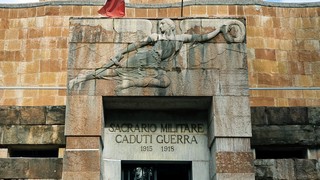
The last little church we want to bring to your attention is the Chapel of the Military Memorial at Pocol, which was erected in 1916 to commemorate the fallen comrades on the Dolomites during the First World War. Later, in 1935, it was decided to build a large ossuary to gather the remains of all 10,554 fallen soldiers, who had been buried in various military cemeteries that did not provide a dignified resting place for the fallen.
The chapel is very simple. Inside, above the entrance door, there is a fresco of the sentinel watching over a fallen comrade in the snow by Pio Solero. Every year, on the day known as Domenica dei Morti, which falls on the same day as Halloween but in Italy has a more solemn meaning, a mass is celebrated in the church of Pocol in memory of all those who died during the 1915 Great War.

If you'd like more information about the Military Memorial of Pocol, we invite you to read the page we have written on the subject:
There are also other small chapels in the area that are not included on this page. These are modest rural or hamlet chapels, often closed to the public or in a state of preservation that makes them inaccessible or unsuitable for visits. For this reason, they have not been described in detail here. Specifically, they are:
- The Church of Our Lady of Defense, in Italian Chiesa della Madonna della Difesa, is located in the area of Val.
- The Church of the Holy Name of Mary, in Italian Chiesa del Santo Nome di Maria, is located in the area of Cojana.
- The Church of the Most Holy Trinity, in Italian Chiesa della Santissima Trinità, is located in the area of Majon.
- The Church of Sancta Maria ad Montes in Via Cantore
- The Chapel at the Tre Croci Pass
- The Cemetery Chapel
In addition to these, there are three small private and inaccessible chapels: the Baby Jesus Chapel in the retirement home, the Franciscan Sisters' Chapel, and the Ursuline Sisters' Chapel.
Thanks to
The creation of this page would not have been possible without the booklet Pietre Vive, le cappelle di Ampezzo attorno alla chiesa madre by the Cooperativa of Cortina. We also want to thank the official website of the Parish of Cortina and the informational leaflets kindly distributed inside some of the churches, such as the Basilica and the Church of San Candido, which were also really helpful.

For the Basilica, much information was also found in the book San Jaco, storia e arte della Parrocchia di Cortina d'Ampezzo, written by Paolo Giacomel.
Conclusion
We hope you liked this page on the Churches of Cortina d'Ampezzo. Before saying goodbye, we would suggest you read our home page, with all the articles we wrote about Cortina d'Ampezzo.
If you want to thank us, you can read the page Support Us. If you only want to suggest a change, propose something, or just say hello, in the section Contacts and Info, you'll find all the ways to reach us.